OCD: quieting a loop that won’t switch off
What OCD is, how it is usually treated, and how TMS can help, in seven steps.
Every step has both. The science view adds the strength of evidence and references.
Understanding OCD
Step 1 of 7
What OCD is.
Obsessive-compulsive disorder (OCD) has two parts. Obsessions are unwanted thoughts or fears that keep coming back and feel impossible to control. Compulsions are things a person feels driven to do to quiet them.
Common themes are germs and cleanliness, checking whether the stove is off or the door is locked, a need for order, and unwanted, upsetting thoughts of causing harm.
About 2 to 3 people in 100 have OCD at some point in life.
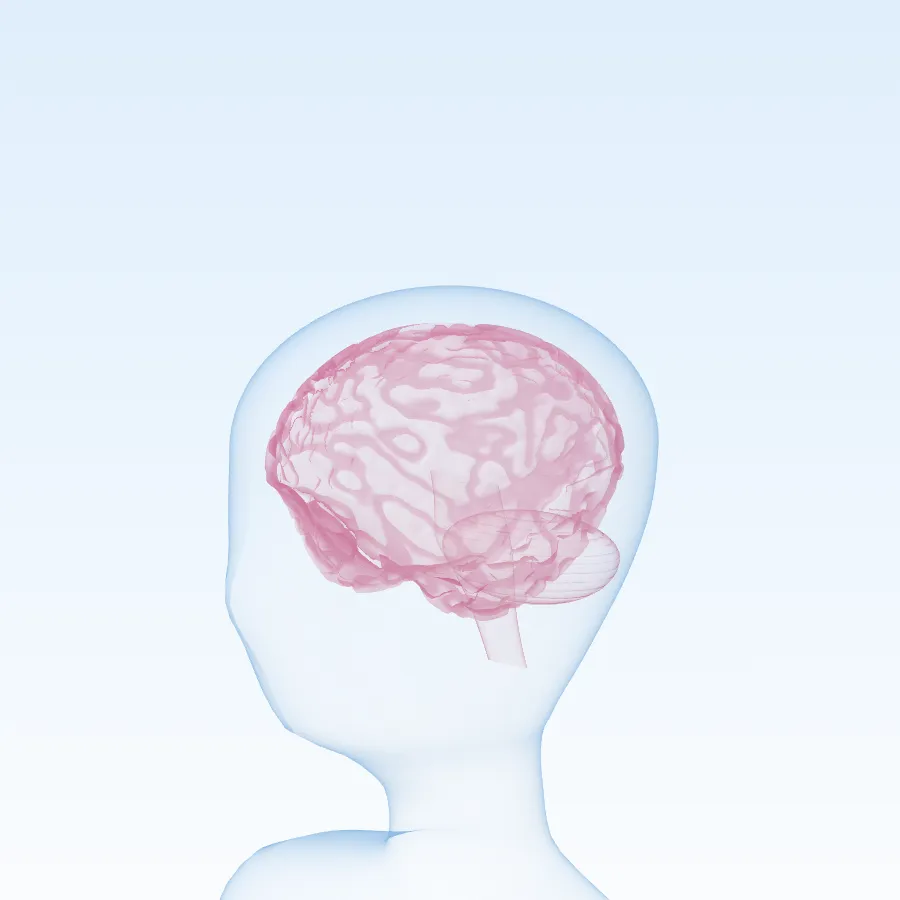
The model shows the head before any treatment.
Definition and prevalence
Well establishedOCD is defined by obsessions (recurrent, intrusive, unwanted thoughts, urges or images) and compulsions (repetitive behaviors or mental acts performed to reduce distress). Common symptom dimensions are contamination and cleaning, doubt and checking, symmetry and ordering, and unacceptable or taboo thoughts, such as intrusive thoughts of causing harm. Lifetime prevalence is about 2% to 3%.
Step 2 of 7
A cycle that feeds itself.
The worry builds anxiety. Checking the lock, washing the hands, or bathing in a long ritual brings relief, but only for a short time. Then the worry returns and the cycle starts again.
Rituals can take hours of a day. OCD can be very disabling, and it is not a matter of willpower.
In the brain, a circuit that detects threats is overactive. It keeps signaling that something is wrong.
The model shows the loop in orange, with signals circling through it.
Hyperactive cortico-striato-thalamo-cortical circuitry
Well establishedFunctional imaging consistently shows hyperactivity in the orbitofrontal cortex, anterior cingulate cortex, caudate and thalamus in OCD, which is strongest during symptom provocation. These regions form CSTC loops involved in error detection and habit, consistent with the repetitive “something’s wrong” signal patients describe.
Treatments
Step 3 of 7
The first treatments: therapy and medicine.
The best-studied talk therapy is exposure and response prevention (ERP), a form of cognitive behavioral therapy. With a therapist, you face a feared situation in small steps and practice not doing the ritual.
The main medicines are SSRIs. For OCD they often work best at higher doses than for depression, sometimes above the usual maximum, and they need 8 to 12 weeks to judge.
If that is not enough, a second medicine can be added, such as clomipramine or a low dose of an antipsychotic medicine. Therapy and medicine together help many people a great deal.
In the model, the loop keeps signaling while the first treatments are tried.
First-line and augmentation strategies
Well establishedFDA labeling / guidelinesFirst-line treatment is a serotonin reuptake inhibitor, cognitive behavioral therapy with exposure and response prevention, or both. Higher SSRI doses produce greater average improvement in OCD, and a trial should last at least 8 to 12 weeks at an adequate dose. Clomipramine is also effective, with a heavier side effect burden.
For patients who do not respond to SSRIs, augmentation with an atypical antipsychotic such as aripiprazole or risperidone has meta-analytic support. Doses above the labeled maximum are an off-label practice that requires monitoring.
Step 4 of 7
When that is not enough: TMS.
About 4 to 6 people in 10 still have troubling symptoms after the first treatments. This is called treatment-resistant OCD, and it is common.
TMS is another option. The FDA cleared the first TMS device for OCD in 2018, and the system we use was cleared in 2020.
For OCD, a coil designed to reach deeper is placed at the top of the head, toward the front. TMS is added to your therapy and medicine. It does not replace them.
In the model, this second coil sits at the top of the head, above the loop.
A deeper target: medial prefrontal cortex and anterior cingulate
Well establishedFDA labeling / guidelinesAn estimated 40% to 60% of patients do not respond, or respond only partially, to first-line treatment. Deep TMS with the H7 coil was cleared by the FDA for OCD in August 2018, and MagVenture TMS Therapy with the Cool D-B80 double-cone coil was cleared in August 2020, both as an adjunct to existing treatment.
OCD protocols target the dorsomedial prefrontal cortex and anterior cingulate. This differs from depression protocols, which target the left dorsolateral prefrontal cortex. A common target is about 4 cm anterior to the leg motor hotspot.
Step 5 of 7
Quieting the loop.
The pulses reach the middle front of the brain and a deeper area called the anterior cingulate. Both are part of the overactive loop.
Over a course of sessions, the loop can quiet down. For many people, obsessions and urges become easier to resist, at least for a period of time.
In the model, the signals in the loop slow down, and the loop turns from orange to green.
Proposed mechanism: modulation of the CSTC loop
Human evidenceLeading modelStructures in the cortico-striato-thalamo-cortical loop are hyperactive at rest in OCD, more so after symptom provocation, and their activity has been reported to decrease after successful treatment. High-frequency stimulation of the medial prefrontal cortex and anterior cingulate is thought to modulate this loop. The mechanism is less established than for TMS in depression.
Results
Step 6 of 7
How well it works.
Doctors measure OCD with the Yale-Brown Obsessive Compulsive Scale, or Y-BOCS. It asks 10 questions about how much time obsessions and compulsions take and how much they interfere with life. Scores run from 0 to 40.
A response means the score falls by at least 30%. In the main trial, about 4 in 10 people responded to TMS, compared with about 1 in 10 who received a placebo treatment.
Everyone in that trial had already tried medicine or therapy without enough relief. In everyday clinics, more than half of patients have responded.
In the model, the loop is shown after a course of treatment, calmer and green.
Sham-controlled and real-world outcomes
Human evidenceIn the multicenter sham-controlled trial (99 patients, 11 sites), 38.1% of patients receiving active deep TMS met response criteria (a reduction of at least 30% in Y-BOCS score) after 6 weeks, compared with 11.1% with sham. Mean Y-BOCS reductions were 6.0 and 3.3 points. One month later, response rates were 45.2% and 17.8%.
In post-marketing data from 22 clinics (219 patients), 57.9% of patients with a Y-BOCS score after 29 sessions were responders, and first response came after an average of 18.5 sessions. These data are uncontrolled and were collected with the H7 coil. We treat with the Cool D-B80 coil, which is FDA-cleared for the same target.
Your visit
Step 7 of 7
What a course is like.
A course is about 29 sessions over 6 weeks. The stimulation takes about 18 minutes.
A session starts with a few minutes of bringing one of your own worries to mind. This switches the loop on, which seems to help the treatment reach it.
You sit awake in a treatment chair, wearing earplugs. Afterward, you can drive yourself home and go about your day. Keep going with your therapy and your medicine during the course.
The model shows the coil at the top of the head, in position for a session of around 20 minutes.
Protocol and safety
FDA labeling / guidelinesThe cleared protocol delivers high-frequency (20 Hz) stimulation in daily sessions for 6 weeks, 29 sessions in all, each preceded by brief individualized symptom provocation. Intensity is set relative to the leg motor threshold. No anesthesia or sedation is used, and hearing protection is required.
The most common adverse effect is headache. Seizure is rare. How long the benefit lasts varies, and some patients return for further sessions.
What a session is like
- You are awake, seated in a comfortable chair. No anesthesia or sedation.
- It starts with a few minutes of thinking about one of your own worries.
- You will hear clicking and feel tapping at the top of your head for about 18 minutes.
- Afterward, you can drive and go about your day.
Good to know
- TMS for OCD is added to therapy and medicine. It works alongside them.
- The most common side effect is headache, which usually eases after the first few sessions. Seizures are rare.
- Insurance coverage for OCD varies by plan. We check yours before you start.
Clinical status
- FDA-cleared deep TMS for OCD since 2018 (H7 coil); MagVenture TMS Therapy with the Cool D-B80 coil cleared in 2020 as an adjunct treatment for adults with OCD.
- Target: dorsomedial prefrontal cortex and anterior cingulate, with symptom provocation before each session.
- Evidence: one pivotal sham-controlled multicenter trial, supported by post-marketing data from routine practice.
These pictures simplify how TMS is thought to work in OCD. Results vary from person to person. For education only; this is not medical advice. Ask your care team whether TMS is right for you.
The science view summarizes mechanisms and the strength of evidence for each step. Individual results vary. For education only; this is not medical advice.
The takeaway
- OCD is a cycle of unwanted worries and rituals, driven by an overactive loop in the brain.
- Therapy and medicine come first. About 4 to 6 people in 10 need more.
- TMS is added to those treatments. In the main trial, about 4 in 10 people responded, compared with about 1 in 10 on a placebo treatment.
What you can do next
- Keep going with your therapy and your medicine.
- List the OCD treatments you have tried, with doses if you know them.
- Request a consultation to ask what fits you.
Ready to take the next step?
Your first consultation is an evaluation, not a commitment to any treatment. Our patient advocate calls you back within one business day.