What antidepressant pills really do
The main types of antidepressant pills, in eight steps.
Every step has both. The science view adds the strength of evidence and references.

Step 1 of 8
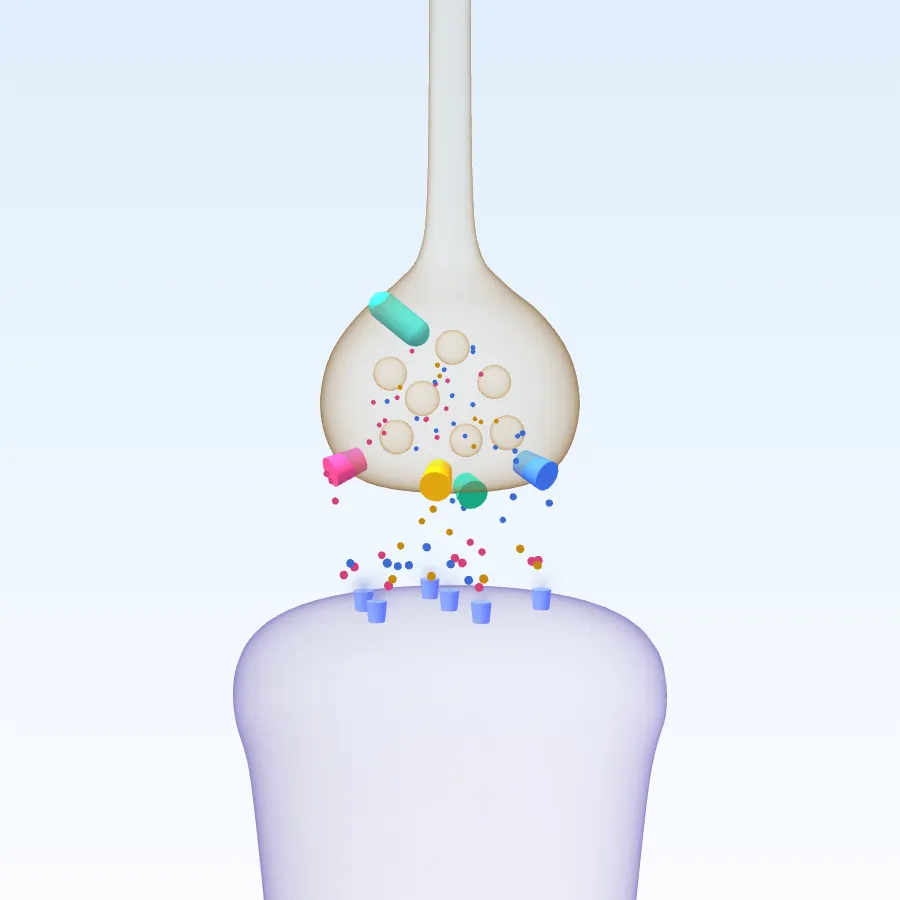
Messages between nerve cells.
Nerve cells pass chemical messengers like serotonin and norepinephrine across a tiny gap. Then recycling pumps pull the messengers back in.
In the model, the sending cell is at the top and the receiving cell is at the bottom. Serotonin is shown in pink, norepinephrine in blue, and dopamine in gold.
Monoamine neurotransmission and reuptake
Well establishedMonoamines such as serotonin (5-HT), norepinephrine (NE) and dopamine (DA) are released from presynaptic vesicles, act on postsynaptic receptors, and are cleared mainly by reuptake through SERT, NET and DAT. Monoamine oxidase (MAO) then breaks them down inside the terminal. Most antidepressants act on one or more of these steps.
Step 2 of 8
SSRIs: serotonin stays longer.
SSRIs like sertraline, escitalopram and fluoxetine slow the serotonin pump, so serotonin stays in the gap longer.
In the model, the pink serotonin pump is blocked, and more serotonin stays in the gap.
Selective serotonin reuptake inhibitors
Well establishedSSRIs bind SERT and inhibit serotonin reuptake, increasing synaptic 5-HT. They are first-line for major depression because of efficacy comparable to other classes and favorable tolerability. Common early effects include nausea and sleep change; sexual side effects are frequent.
Step 3 of 8
SNRIs: two pumps slowed.
SNRIs like venlafaxine, duloxetine and desvenlafaxine slow both the serotonin and norepinephrine pumps.
In the model, both pumps are blocked, so both messengers stay in the gap longer.
Serotonin–norepinephrine reuptake inhibitors
Well establishedSNRIs inhibit SERT and NET. Venlafaxine is serotonin-predominant at low doses, with NET inhibition increasing at higher doses. Duloxetine is also approved for several pain conditions. Blood pressure can rise, and discontinuation symptoms are common if stopped abruptly.
Step 4 of 8
Bupropion: a different pair.
Bupropion works on the norepinephrine and dopamine pumps instead, and leaves serotonin alone. It’s less likely to cause sexual side effects or weight gain.
In the model, the blue and gold pumps are blocked, and the pink serotonin pump stays open.
Norepinephrine–dopamine reuptake inhibition
Well establishedBupropion is a NET and DAT inhibitor with no meaningful serotonergic activity. It has low rates of sexual dysfunction and weight gain, and it lowers the seizure threshold in a dose-dependent way. It is commonly used alone or to augment SSRIs.
Step 5 of 8
Mirtazapine: more messengers released.
Mirtazapine blocks receptors that normally slow messenger release (alpha-2 receptors), so the sending cell releases more serotonin and norepinephrine. It often helps with sleep and appetite.
In the model, the blocked receptor is the green one on the sending cell.
α2 antagonism and receptor blockade
Well establishedMirtazapine antagonizes presynaptic α2-adrenergic autoreceptors and heteroreceptors, increasing norepinephrine and serotonin release. It also blocks 5-HT2 and 5-HT3 receptors, which reduces nausea and sexual side effects, and H1 receptors, which causes sedation and increased appetite.
Step 6 of 8
Older, effective options.
Tricyclics slow several pumps at once. MAOIs stop a breakdown enzyme from clearing messengers. Both can work well but need closer monitoring, and MAOIs need diet precautions.
In the model, two pumps are blocked for the tricyclics, and the enzyme inside the sending cell is blocked for the MAOIs.
TCAs and MAOIs
Well establishedTricyclic antidepressants inhibit SERT and NET and also block muscarinic, histamine and α1 receptors, causing anticholinergic effects, sedation and orthostasis; they are dangerous in overdose. MAOIs irreversibly inhibit monoamine oxidase, raising monoamine levels; they require dietary tyramine restriction and careful attention to drug interactions, including serotonin syndrome risk.
Step 7 of 8
Why it takes weeks.
Messenger levels rise within hours, but mood usually improves over several weeks. Cells need time to adapt and build stronger connections. That’s why it helps to stick with a medicine long enough.
In the model, the timeline runs from hours to weeks, and new connection points appear on the receiving cell.
Delayed onset: adaptation and plasticity
Leading modelEvidence mixedReuptake inhibition is immediate, but clinical benefit typically develops over weeks. Proposed explanations include desensitization of inhibitory autoreceptors, downstream changes in gene expression and BDNF-related neuroplasticity. Pooled data show that some improvement often begins within the first 2 weeks.
Step 8 of 8
When medicines aren’t enough.
If two or more antidepressants haven’t helped enough, it’s called treatment-resistant depression. It’s common, and it’s not your fault. Other treatments can help.
The model shows four of them: TMS, esketamine, ketamine and VNS.
Treatment-resistant depression
Human evidenceTRD is usually defined as an inadequate response to at least two adequate antidepressant trials in the current episode. In STAR*D, remission became less likely with each successive medication step; a later reanalysis reported lower cumulative remission than the original report. Neuromodulation and NMDA-targeting treatments are evidence-based options for TRD.
Good to know
- Different medicines suit different people. Side effects and response vary.
- Don’t stop an antidepressant suddenly. Talk with your prescriber first.
- Many people try more than one medicine, or a combination, before finding the right fit.
Ask your care team
- How long should I give this medicine before deciding if it works?
- Which side effects should I watch for?
- What are my options if this isn’t enough?
Beyond monoamines
- Vortioxetine combines SERT inhibition with direct action on several serotonin receptors.
- Atypical antipsychotic augmentation (for example aripiprazole, brexpiprazole, cariprazine, quetiapine XR) is FDA-approved as adjunctive therapy for major depression.
- Newer mechanisms: NMDA-targeting agents (esketamine; dextromethorphan–bupropion) and GABA-A modulators (zuranolone for postpartum depression).
These pictures simplify how antidepressants are thought to work. Medicine names are examples, not recommendations. Individual results vary. For education only; this is not medical advice. Never start, stop or change a medicine without talking to your prescriber.
The science view summarizes mechanisms and evidence for each class. Individual results vary. For education only; this is not medical advice.
The takeaway
- Antidepressants change how chemical messengers pass between nerve cells.
- Each type acts differently, so one may help when another did not.
- They take weeks to work. When medicines are not enough, there are other treatments.
What you can do next
- Do not stop a medicine suddenly. Talk with your prescriber first.
- Keep a list of what you have tried and how it went.
- Read “When the first treatment doesn’t work.”
Ready to take the next step?
Your first consultation is an evaluation, not a commitment to any treatment. Our patient advocate calls you back within one business day.